
Utility Company vs. Homeowner: Who is Responsible for Gas Line Repairs?
Nicor Gas is legally and financially responsible for all public gas mains in the street and the service lateral leading up to the utility meter, including the meter body itself. The property owner owns and is solely responsible for all gas piping starting from the outlet swivel connection of the meter into the home, including interior distribution manifolds, branch lines, and appliance valves.
Key Responsibility Takeaways
- Nicor's Free Service: Leaks at the meter body, outdoor regulator, or street main are repaired at $0 cost to the property owner.
- Homeowner's Private Domain: Any leak inside the basement, crawlspace, or behind walls must be repaired by a licensed plumber at the owner's expense.
- Red-Tag Procedure: If the leak is on private piping, Nicor padlocks the meter until the homeowner's plumber certifies repairs.
- Insurance Protection: Standard homeowner policies exclude pipe wear-and-tear but cover resulting explosion or fire damage.
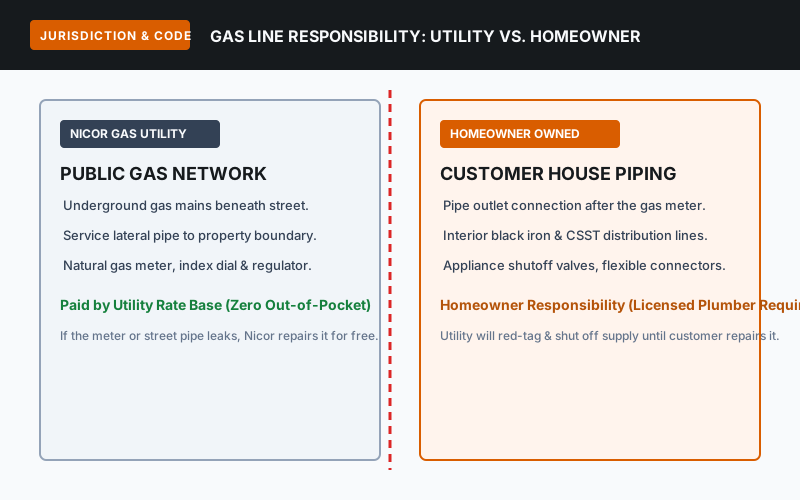
The Gas Meter Demarcation Point in Illinois
When homeowners in Elmhurst or Lombard notice a gas smell, their immediate reaction is often to call Nicor Gas expecting the utility to fix the problem completely. While calling Nicor is the correct life safety step, homeowners are often shocked when the utility technician identifies an indoor leak, padlocks the meter, and hands them an orange or red tag stating that private repairs are required.
Under the Illinois Commerce Commission (ICC) regulations and the Illinois Public Utilities Act (220 ILCS 5), public gas utilities operate under a strict demarcation boundary:
What Nicor Gas Owns (Utility Responsibility - $0 to Homeowner)
Nicor Gas maintains all public distribution infrastructure paid for through regulated utility rate bases:
- Underground Street Mains: High-pressure and intermediate-pressure distribution pipelines beneath municipal roadways.
- Service Lateral Line: The underground pipe extending from the street main across your yard up to your home's exterior foundation.
- Service Riser & Inlet Valve: The vertical pipe that rises out of the ground into the meter assembly.
- Pressure Regulator: The heavy-duty bell-shaped regulator that steps utility pressure down to standard residential operating pressure (approx. 1/4 PSI).
- Gas Meter Body & Index Dial: The physical utility meter that measures fuel consumption.
If any of these components leak, Nicor will dispatch a field crew, isolate the street lateral, replace the meter body or regulator, and complete the repair at zero out-of-pocket cost to you.
What the Property Owner Owns (Private Financial Responsibility)
The property owner's legal responsibility begins at the outlet connection swivel nut of the gas meter. Everything downstream belongs to the homeowner:
- The House Service Line: The black steel pipe that leaves the meter outlet and penetrates through the foundation wall into the basement or crawlspace.
- Interior Distribution Manifolds: All black iron, steel, or CSST supply trunks running along basement ceiling joists.
- Drop Legs & Branch Runs: Vertical and horizontal pipe branches leading to furnaces, boilers, water heaters, and fireplaces.
- Manual Appliance Shutoffs: All individual gas valves in utility rooms, kitchens, and laundry rooms. Learn more about gas shutoff valve replacement.
- Flexible Appliance Connectors: The yellow corrugated stainless steel connectors linking appliances to supply valves.
Demarcation Summary Table
| Infrastructure Component | Legal Owner | Who Performs Repair? | Financial Responsibility |
|---|---|---|---|
| Gas Main in Street | Nicor Gas | Nicor Utility Crews | $0 (Utility Rate Base) |
| Underground Yard Service Lateral | Nicor Gas | Nicor Utility Crews | $0 (Utility Rate Base) |
| Gas Meter & Regulator | Nicor Gas | Nicor Field Tech | $0 (Utility Rate Base) |
| Meter Outlet Swivel Fitting | Property Owner | Licensed Plumber | Homeowner Expense |
| Interior Distribution Piping | Property Owner | Licensed Plumber | Homeowner Expense |
| Appliance Valves & Flex Lines | Property Owner | Licensed Plumber | Homeowner Expense |
Why Nicor Cannot Repair Your Private Gas Lines
Homeowners frequently ask why Nicor technicians cannot simply tighten a leaking pipe union while they are on site. There are three key reasons:
- Legal Liability: Public utilities are prohibited from performing interior contracting work on private residential piping. If a utility technician worked on private pipe and a subsequent failure occurred, the utility would bear catastrophic civil liability.
- Plumbing Code Jurisdiction: Under the Illinois Plumbing License Law, repairs to private residential fuel gas piping must be executed by an Illinois-licensed plumbing or mechanical contractor who holds municipal bonding and permits.
- Mandatory Pressure Testing: Once a leak is detected on customer piping, safety regulations mandate a formal 15-minute manometer air pressure test before gas can be reintroduced. Nicor requires the independent contractor to certify that test. See our pressure testing guide.
For comprehensive details on what repairs typically entail, consult our gas leak repair cost factors guide. If you are dealing with a red-tagged meter right now, contact LeakSecure Gas Dispatch at (630) 555-0100 to connect with a licensed independent contractor for code-compliant gas leak repair in Lombard.
Frequently Asked Questions
Where is the exact legal boundary between Nicor Gas and the homeowner?
The legal boundary is the outlet swivel nut connection of the natural gas meter. Everything upstream (the street main, the service lateral pipe underground, the inlet service valve, the pressure regulator, and the meter body) is owned and maintained by Nicor Gas. Everything downstream of the outlet swivel (the pipe entering your home, basement manifolds, branch lines, valves, and appliance connectors) is owned by the property owner.
Will homeowners insurance cover gas line repairs in Illinois?
Standard homeowners insurance policies typically do NOT cover normal wear-and-tear, joint corrosion, or age-related pipe leaks. However, if a gas leak causes an explosion or fire, resulting structural damage is generally covered. Some homeowners carry optional service line endorsements or utility piping protection riders that reimburse private line replacement costs.