
What to Do If You Smell Gas: Immediate Safety Checklist Before Calling
If you smell sulfur or rotten eggs inside your home, evacuate all occupants and pets immediately. Do not touch light switches, operate garage doors, or use cellular phones inside. Leave doors open as you exit to ventilate trapped gas, walk to a safe distance outdoors, and dial Nicor Gas at 888-642-6748 or call 911 before contacting a repair plumber.
Zero-Spark Rules in Effect
Natural gas becomes flammable when mixed with air at concentrations between 5% and 15% (the explosive range). At this ratio, a static spark from synthetic clothing, a refrigerator motor clicking on, or a mobile phone vibrating can detonate the gas. Treat any strong gas odor as an immediate explosion hazard.
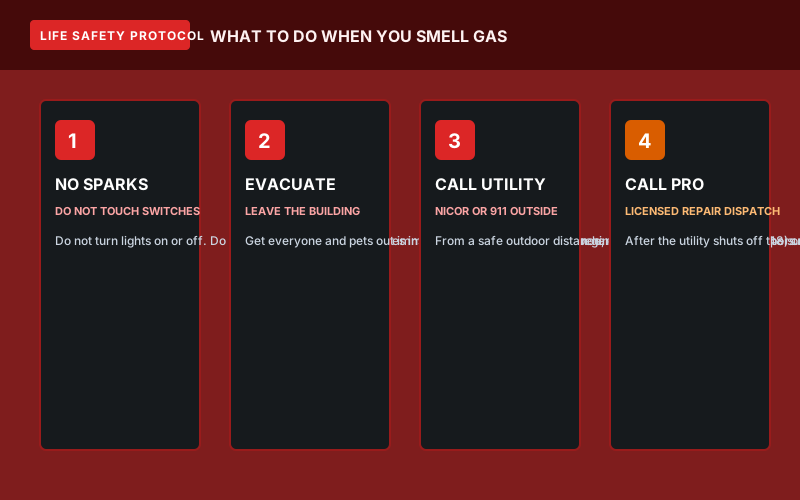
The 4-Step Emergency Evacuation Checklist
Step 1: Do Not Create Any Sparks
Your natural instinct when entering a dark, smelly room is to flip on the light or unplug an appliance. In a gas leak, this can be fatal. Strictly adhere to these rules:
- Do NOT touch light switches: Leave lights exactly as they are (if on, leave on; if off, leave off).
- Do NOT use landline or cell phones inside: Internal relays and touchscreens generate micro-sparks.
- Do NOT open or close electric garage doors: Garage door motors pull heavy amperage that arcs across brushes.
- Do NOT start cars parked in the garage or driveway: Starter motors and exhaust heat can ignite outdoor gas plumes.
- Do NOT light matches, candles, or lighters: Open flames are strictly prohibited.
Step 2: Evacuate the Building Immediately
Gather all family members, children, and pets and walk out immediately. As you leave:
- Leave entry doors wide open behind you. This allows heavier accumulations of gas to naturally ventilate with outdoor air, lowering indoor vapor concentration below the lower explosive limit.
- Do not pause to collect jewelry, computers, or winter coats. Seconds matter if gas concentrations are near ignition thresholds.
- Walk across the street or down the block, maintaining a minimum distance of at least 300 feet upwind from the structure.
Step 3: Call Nicor Gas or 911 from Outdoors
Once you are safely outside in fresh Lombard air:
- If you hear loud roaring or smell intense gas: Dial 911 immediately to dispatch the local Lombard Fire Department. Firefighters carry explosion-proof equipment to establish a perimeter and protect neighboring homes.
- Call Nicor Gas Emergency Hotline: Dial 888-642-6748 (available 24/7). Nicor will dispatch a field technician to test the atmosphere, inspect the service connection, and shut off the gas supply at the street or meter.
Step 4: Contact a Licensed Repair Contractor
When Nicor arrives, they will isolate the hazard. If the leak is on the private house piping, Nicor will padlock the meter and issue a red tag. At this point, the utility's emergency role ends.
You must then contact a licensed mechanical plumbing contractor to find the leak, rebuild the defective pipe, and execute a code-certified pressure test. Call LeakSecure Gas Dispatch at (630) 555-0100 to connect with a licensed contractor specializing in emergency gas leak repair in Lombard.
What Happens During Nicor's Emergency Response?
When a Nicor field technician arrives at your home, they follow strict safety guidelines:
- They use an intrinsically safe combustible gas indicator (CGI) to measure methane levels outside your foundation and at door seals.
- If interior access is safe, they locate the meter and isolate the main supply valve using a specialized utility key.
- They perform a differential pressure test across the meter index. If pressure holds steady, the leak was likely a burner valve left slightly ajar. If pressure decays, an active pipe rupture exists downstream.
- They install a tamper-resistant padlock on the meter valve, hang a red warning tag, and advise you to hire a licensed contractor before service can be reconnected. Learn more in our utility responsibility guide.
Frequently Asked Questions
Why is it dangerous to flip a light switch if you smell gas?
When a common mechanical wall switch is flipped on or off, a tiny electrical micro-arc jumps across the internal copper contacts. In a room where escaping natural gas has mixed with air to reach the lower explosive limit (5% concentration), that microscopic spark possesses enough thermal energy to ignite the air-fuel mixture instantly, causing a devastating structure explosion.
Should I attempt to turn off my own gas meter before evacuating?
Only if your gas meter is located outdoors, is readily accessible, you already have an adjustable wrench on hand, and you can shut it off in under 15 seconds without delaying evacuation. Never enter a gas-filled basement to search for an interior shutoff valve.