
Electronic Gas Sniffers vs. Soapy Water: How Technicians Pinpoint Leaks
Electronic combustible gas detectors use heated metal-oxide semiconductor or catalytic bead sensors to measure electrical resistance changes caused by hydrocarbon molecules down to 1 PPM, pinpointing hidden leaks behind walls and joists. Certified bubble testing fluids use non-corrosive, chloride-free surfactants to visually verify and confirm expanding foam clusters on exposed pipe threads without causing metal corrosion.
Key Diagnostic Principles
- Two-Step Protocol: Technicians use electronic sniffers to find the general leak zone, then apply certified fluid to pinpoint the exact fitting.
- Parts-Per-Million Sensitivity: Solid-state sensors detect leaks at 20 to 50 PPM, long before gas reaches human odor thresholds (approx. 5,000 PPM).
- Corrosion Danger: Dish soap contains salts that induce stress-corrosion cracking on brass valves over time.
- Pressure Decay Proof: Bubble tests only locate leaks; manometer air tests prove the overall system is 100% gastight.
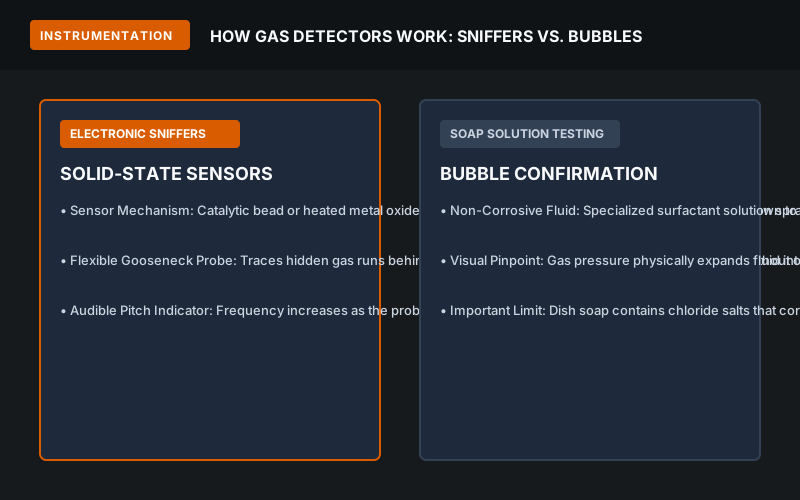
The Science of Electronic Combustible Gas Sniffers
Handheld combustible gas indicators (CGIs), often called "electronic sniffers," are the primary diagnostic tool used by licensed gas contractors across Downtown Lombard and DuPage County. These portable instruments detect methane (CH4), propane (C3H8), and other volatile hydrocarbons.
1. Catalytic Bead (Pellistor) Sensors
A catalytic bead sensor contains two miniature coils of fine platinum wire embedded in ceramic beads. One bead is coated with a catalyst (such as palladium), while the other remains untreated as a reference.
When air drawn across the probe tip contains combustible gas, the gas oxidizes on the catalytic bead, producing micro-combustion that raises the bead's temperature. This temperature increase raises electrical resistance across the Wheatstone bridge circuit. The instrument translates this electrical imbalance into an audible ticking frequency that speeds up as the probe nears the leak, while displaying a digital PPM reading.
2. Metal-Oxide Semiconductor (MOS) Sensors
Modern high-sensitivity sniffers frequently employ tin dioxide (SnO2) semiconductor elements heated to roughly 300°C. In clean air, oxygen atoms bind to the semiconductor surface, trapping electrons and maintaining high electrical resistance.
When reducing gases like methane contact the sensor surface, they react with the adsorbed oxygen, releasing electrons back into the semiconductor matrix. This causes an instantaneous drop in electrical resistance, allowing the detector to register hydrocarbon concentrations as low as 1 to 10 PPM.
Why Electronic Sniffers Beat Soapy Water in Real Homes
While soapy water has been used by plumbers for decades, electronic detectors provide decisive advantages in residential troubleshooting:
- Tracing Concealed Piping: Gas pipes routinely travel through floor joists, behind drop ceiling tiles, and down enclosed drywall wall chases. An electronic sniffer with a flexible 18-inch gooseneck probe can sample air at baseboard seams, electrical outlet boxes, and ceiling cutouts without opening walls.
- Detecting Micro-Weeps: Very small leaks (such as a slow weep on a water heater drop leg) release gas at rates too low to blow a bubble through heavy liquid, yet an electronic sniffer will register 150 PPM instantly.
- No Cleanup or Mess: Liquid leak detectors create puddles and can short out electrical components inside furnace blower cabinets. Electronic sniffers are completely non-invasive.
When Certified Bubble Testing Solution is Still Needed
Despite electronic sniffer sensitivity, liquid leak detection fluid remains an indispensable secondary tool for one specific task: visual pinpoint confirmation.
Because gas molecules disperse quickly through ambient air currents, a sniffer wand may alert strongly anywhere within an 18-inch radius of a furnace manifold. To determine whether the leak is on the union, the shutoff valve stem, or the threaded pipe nipple, the technician applies certified leak detector fluid.
The Difference Between Dish Soap and Certified Fluid
Never allow a contractor or handyman to spray Dawn or Palmolive dish soap on your gas lines:
- Dish Soap: Formulated with chloride salts and ammonium sulfates. When sprayed onto brass flare fittings or flexible stainless steel connectors, these chemical residues trigger rapid stress-corrosion cracking within months.
- MIL-PRF-25567E Certified Fluid: Non-halogenated, zero-chloride, neutral pH formulations that contain specialized high-viscosity synthetic polymers. The fluid clings to vertical pipe threads and forms expanding, persistent white foam clusters over micro-fissures without causing chemical corrosion.
Diagnostic Comparison Table
| Diagnostic Tool | Sensitivity Range | Primary Strength | Limitations |
|---|---|---|---|
| Electronic MOS Sniffer Wand | 1 to 50,000 PPM | Finds leaks behind walls & unexposed joists | Cannot pinpoint exact thread seam if air is turbulent |
| Certified Surfactant Bubble Fluid | Visual (>500 PPM) | Visually confirms exact microscopic thread leak | Only works on fully exposed accessible fittings |
| Water Column Manometer Gauge | 0.1 Inches W.C. | Proves entire household system is 100% gastight | Does not show where the leak is located |
| Household Dish Soap & Water | Uncalibrated / Poor | None (DO NOT USE) | Causes severe stress-corrosion cracking on brass |
Professional Gas Leak Tracing in Lombard
If you smell gas or suspect a line issue, rely on licensed contractors equipped with calibrated electronic sniffers and certified diagnostic fluids.
Contact LeakSecure Gas Dispatch at (630) 555-0100 to connect with a licensed independent contractor for precision gas leak detection in Lombard.
Frequently Asked Questions
Can electronic gas sniffers detect leaks through drywall?
Yes. Because natural gas (methane) is lighter than air and escapes under pressure, it migrates through wall cavities and exits through baseboard gaps, electrical outlet faceplates, and switch boxes. A technician using an electronic sniffer with a flexible gooseneck probe can sample air at these wall penetrations and detect methane down to 1 PPM without opening drywall.
What makes certified leak detection fluid different from regular soap?
Certified leak detection fluids (meeting MIL-PRF-25567E specifications) contain zero chlorides, ammonia, or halogenated compounds. Regular household dish soaps contain salts that induce rapid stress-corrosion cracking on brass valves and copper piping. Certified fluids also possess specialized high-viscosity surfactants that form long-lasting, micro-bubble clusters over the smallest pinhole leaks.