
Natural Gas Leak vs. Carbon Monoxide: Symptoms, Dangers & Detection
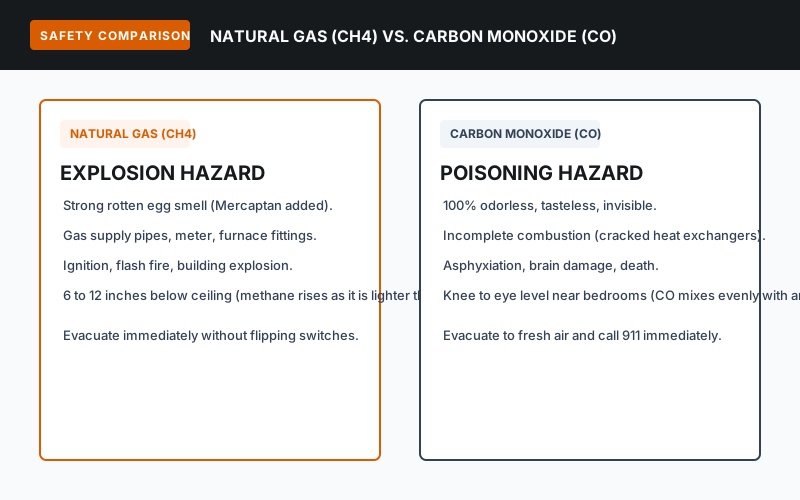
Natural gas (methane, CH4) is an unburned fuel gas that creates an immediate explosion and fire hazard and carries a pungent rotten egg odor (mercaptan). Carbon monoxide (CO) is a completely odorless, colorless toxic gas produced by incomplete combustion that causes silent chemical asphyxiation. Because methane is lighter than air, it rises to ceilings, whereas carbon monoxide matches air density and mixes evenly throughout living spaces.
Crucial Alarm Misconception
Standard residential carbon monoxide alarms do NOT detect natural gas leaks. If your black iron supply pipe ruptures behind a water heater, a CO detector will stay silent until the gas ignites or fills the room. You must have dedicated combustible gas alarms or combined methane/CO detection units to guard against both hazards.
Two Distinct Household Dangers
Homeowners across Glen Ellyn and Lombard frequently confuse natural gas leaks with carbon monoxide problems because both originate around fossil-fuel burning equipment like furnaces, boilers, and water heaters. However, their chemistry, physical behaviors, and lethal mechanisms are fundamentally different.
1. Natural Gas (Methane, CH4)
Natural gas is raw, unburned fuel delivered under pressure by Nicor Gas through underground utility pipelines. It is composed of roughly 90% to 95% methane.
- Primary Hazard: Deflagration and explosion. When methane mixes with room air between 5% and 15% concentration, any electrical spark, pilot light, or open flame will detonate the space.
- Odor Profile: Intense sulfur, rotten eggs, or decaying cabbage, caused by injected mercaptan odorants.
- Vapor Density: 0.60 (Air = 1.0). Methane is 40% lighter than air and naturally pools at the highest point of a room near the ceiling.
- Origin: Escapes from pipe threads, cracked unions, seized valves, or split flexible appliance lines.
2. Carbon Monoxide (CO)
Carbon monoxide is not a fuel; it is a toxic combustion byproduct. It is produced when fossil fuels (natural gas, propane, oil, or wood) burn in an oxygen-depleted environment, known as incomplete combustion.
- Primary Hazard: Chemical poisoning and suffocation. Inhaled CO binds to hemoglobin in human blood 200 times more aggressively than oxygen, forming carboxyhemoglobin and depriving the brain and heart of oxygen.
- Odor Profile: 100% odorless, tasteless, and invisible. It cannot be detected by human senses.
- Vapor Density: 0.97 (Air = 1.0). Carbon monoxide has virtually the identical molecular weight of ambient air, dispersing uniformly throughout an entire home.
- Origin: Escapes from cracked furnace heat exchangers, blocked chimney flues, or improperly drafted water heater exhaust vents.
Side-by-Side Diagnostic Comparison
| Factor | Natural Gas Leak (CH4) | Carbon Monoxide (CO) |
|---|---|---|
| Chemical State | Raw unburned fuel gas | Combustion byproduct |
| Odor & Taste | Rotten eggs (Mercaptan added) | Completely odorless and tasteless |
| Primary Threat | Ignition, flash fire, explosion | Cellular asphyxiation, brain damage, death |
| Detector Type | Combustible gas sniffer (Catalytic/MOS) | Electrochemical CO sensor |
| Sensor Height | 6 to 12 inches below ceiling | Knee-to-chest level (near bedrooms) |
| Typical Source | Threaded pipe unions, appliance flex lines | Cracked furnace heat exchanger, backdrafting flue |
Physical Symptoms: How to Tell Them Apart
Because both hazards displace clean oxygen, early symptoms can overlap, but distinct differences emerge:
- Natural Gas Symptoms: Occupants typically smell sulfur immediately. In high concentrations, oxygen deprivation causes lightheadedness, fatigue, and mild headache that clears rapidly upon stepping outdoors into fresh air.
- Carbon Monoxide Symptoms: Described as "flu-like symptoms without a fever": throbbing frontal headaches, extreme weakness, dizziness, confusion, nausea, vomiting, chest pain, and eventual loss of consciousness. Because CO binds tightly to red blood cells, symptoms do NOT disappear immediately upon stepping outside and require medical oxygen therapy.
Detector Placement Guidelines for Homeowners
Proper alarm placement is essential to ensure early warning:
- Combustible Gas Detectors: Mount high on the wall (within 12 inches of the ceiling) within 10 to 15 feet of gas-burning appliances like the kitchen stove, water heater, and furnace. Because methane rises, ceiling-mounted sensors trigger minutes before gas accumulates down to breathing levels.
- Carbon Monoxide Alarms: Under Illinois Public Act 094-0741 (the Carbon Monoxide Alarm Detector Act), every Illinois residence must have a functioning CO detector within 15 feet of every bedroom. Mount them at eye level or plug them into mid-wall electrical outlets for optimal air sampling.
If your combustible gas alarm sounds or you detect mercaptan odors, evacuate immediately and call 911 or Nicor Gas from outside. Once the utility isolates the meter, contact LeakSecure Gas Dispatch at (630) 555-0100 to connect with a licensed contractor for code-compliant gas leak repair in Lombard.
Frequently Asked Questions
Does a carbon monoxide detector detect natural gas leaks?
No. Standard carbon monoxide alarms use electrochemical sensors designed specifically to measure CO molecules produced by incomplete combustion. They do not respond to raw methane or propane. To detect both hazards, homeowners must install dual-sensor combo alarms or dedicated combustible gas detectors.
Where should a natural gas detector be mounted compared to a CO detector?
Natural gas (methane) has a vapor density of approximately 0.60, making it significantly lighter than air; therefore, combustible gas detectors should be mounted near the ceiling (within 6 to 12 inches of the ceiling). Carbon monoxide has a vapor density of 0.97, matching ambient air, so CO detectors should be installed at knee-to-chest level near sleeping areas.